Specialist Certificate in Building Condition Assessment
Next Intake: 16 April – 22 May 2026 (1 – 2 days a week)
The Specialist Certificate in Building Condition Assessment delivers training in the standardised inspection protocol, data structure and nomenclature and is modelled after Dutch and European standard NEN 2767/CEN-TS/17385.
SGD 2,650.00

Course Description
The pre-condition of an effective maintenance system is reliable inspection data. The inevitable subjectivity of inspectors results in divergent maintenance recommendations; this is an undesirable situation since accommodation, maintenance and other facilities related policies are influenced by the existing condition of facilities. Variability in inspections if not addressed leads to inefficient allocation of budgets for facility maintenance and upkeep.
The Rijksgebouwendienst (RGD) or Dutch Government Building Agency (now functionally merged into the Rijksvastgoedbedrijf (RVB) or Central Government Real Estate Agency] currently manages a large and diverse property portfolio of Dutch Ministries and State properties amounting to some 12.4 million square metres of buildings and 90,000 hectares of land.
In the 80s, RGD developed an inspection system and six-point condition scale to address the subjectivity problem and ensure consistency in condition assessment for its maintenance policy and planning. Buildings/components are assigned a condition score ranging from 1-6 on inspection, 1 being ‘As New’ and 6 being ‘End of Service Life’. During the 90s, the system was further developed in a project supported by the European Commission entitled ‘Condition Assessment and Maintenance Strategies for Buildings and Building Components’; this study was the starting point and basis for the current condition assessment methodology.
RGD and NEN (the Royal Netherlands Standardisation Institute) initiated the establishment of NEN 2767 in 2006 and further developed it for infrastructure work. NEN 2767: Condition Assessment Built Environment’ is now common practice in condition assessments and forms the starting point and baseline for European norm CEN TS/17385 ‘Method for Condition Assessment of Immobile Constructed Assets’
The NEN 2767/CEN TS 17385 standardised condition assessment methodology was transferred to Singapore in 2002 via the Specialist Certificate in Building Inspection/Condition Assessment and is also referred to as the REMMI (Real Estate Management & Maintenance Industry) Inspection System. Several large statutory boards have specified the need for such trained inspectors in outsourced facilities management and maintenance contracts.
The course will provide the knowledge and skills to:
1. Conduct and reduce subjectivity in inspections through a system based on:
- Defects Parameters
- Defects Classification Framework
- Six-Point Condition Scale
- Traditional and Condition-Based/Predictive Maintenance Systems
- Short & Long Term Maintenance Planning
- Condition Assessment Data in Maintenance Planning & Prioritisation
The course comprises of five modules:
M1: Building Degradation & Maintenance
|
M4: Condition Assessment Equipment & Aids
|
M2: Frame of Reference for Condition Assessment / Measurement
|
M5: Condition Assessment of Buildings and Building Components (with Practicum)
|
M3: Protocol for a Condition Assessment
|
Please click here for a list of course lecturers.
60 hours consisting of 7 full days and 1 half day, conducted once / twice per week.
Mode of Delivery
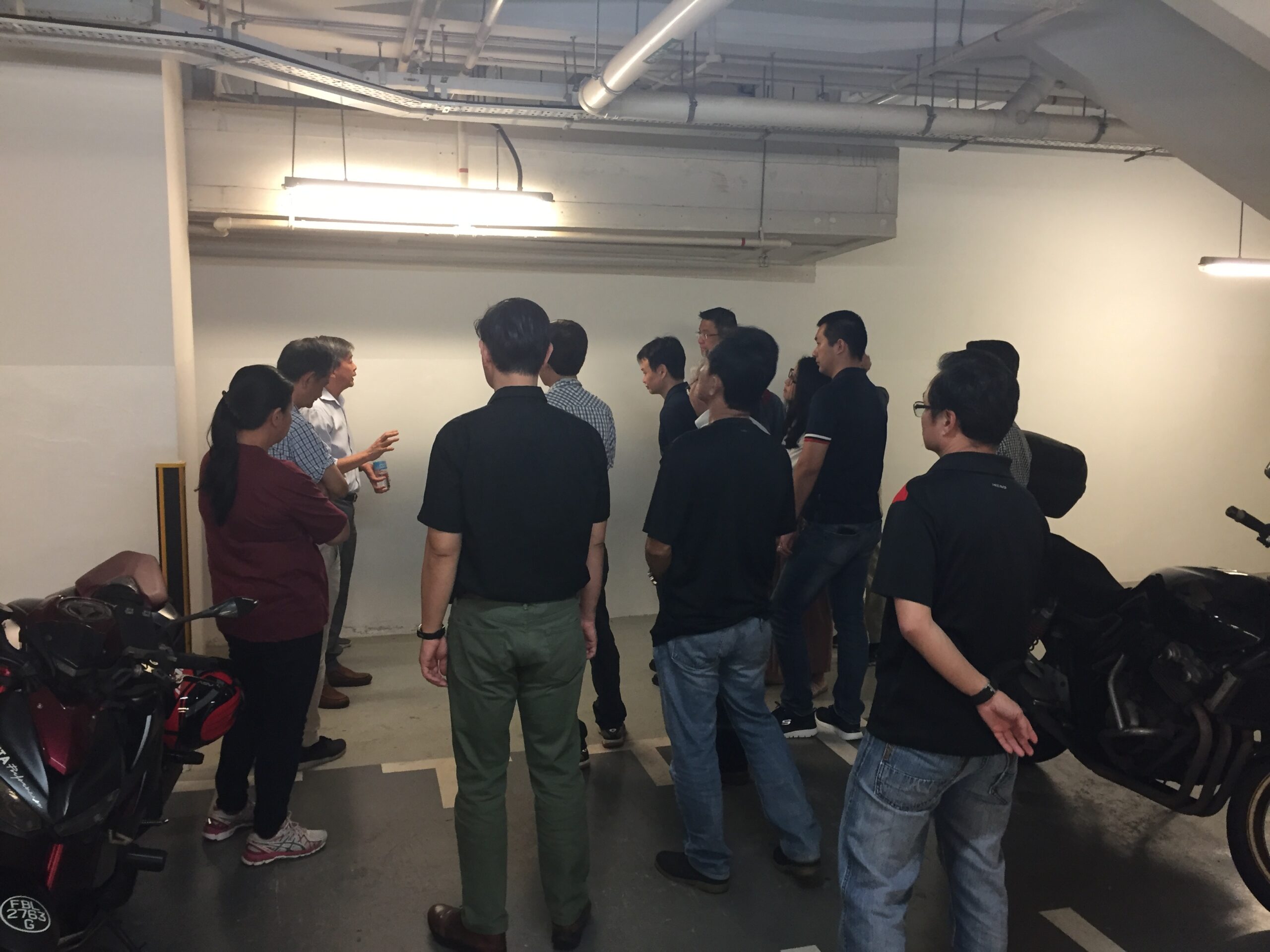
The mode of delivery will comprise face to face lectures in RECA’s training centre in the Devan Nair Institute of Employment and Employability and practicum within and in the surrounds of the centre.
Assessment
Assessment will be in the form of in-person informal formative assessment involving desk top and in practice inspections, reporting and maintenance planning projects issued during the duration of the course. The formal summative assessment can comprise a desk top or real life project for individual or group work.
Certification
The RECA Specialist Certificate in Building Condition Assessment will be issued when a learner passes the formal summative assessment.
- Applicants are expected to have the following qualification for direct entry:
- Diploma in Building/Real Estate Management from Singapore/Ngee Ann Polytechnic; with
- At least 2 years work experience in Facilities Management
- A minimum of C6 in English at O/N levels or equivalent.
RECA will assess all other engineering-based qualifications or equivalent on a case-by-case basis and propose bridging courses to meet the entry requirements, where applicable.
The next intake of the Specialist Certificate in Building Condition Assessment has been scheduled as follows: 16 April – 22 May 2026.
Please click on the dates above for the detailed schedule.
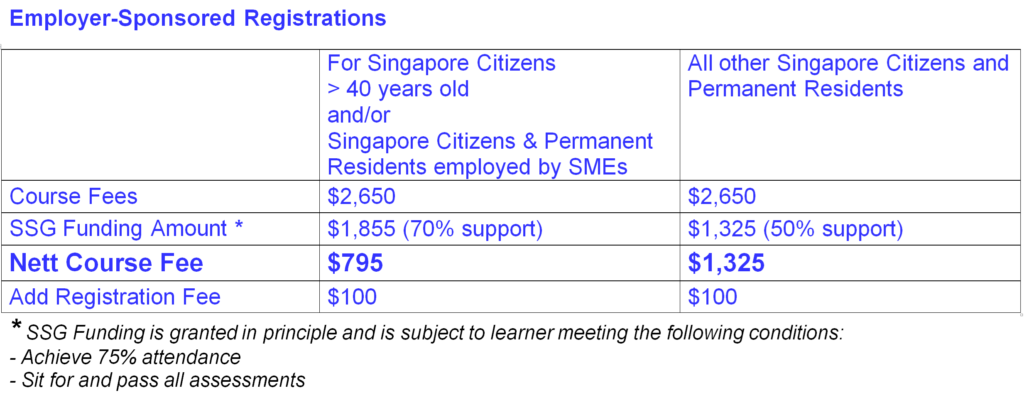
Course Fees: $2,650
SSG Funding Overview
Absentee Payroll Support of up to $4.50 per training hour is also available, capped at $100,000 per enterprise per calendar year.
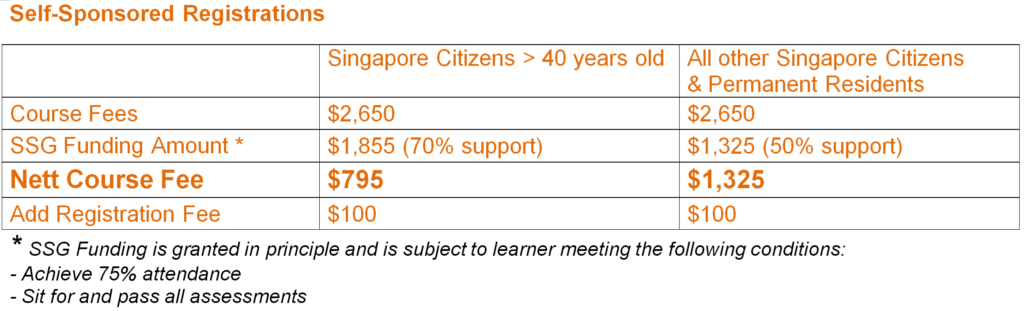
Self-sponsored learners who wish to enrol on the course can also utilise their Opening Skills Future Credit (SFC) to offset the course fee amount after SSG funding. An SFC claim can be made at:
https://www.myskillsfuture.gov.sg/content/portal/en/career-resources/career-resources/how-to-guides/claim-sfc.html
Other Support
Additional NTUC-UTAP Funding
Self-sponsored learners who are NTUC members can enjoy 50% unfunded* course fee support for up to $250 each year when they successfully complete the course. NTUC members aged 40 and above will get increased funding support from $250 to $500. To find out more about NTUC-UTAP or to make a claim, please click on the link below:
https://www.ntuc.org.sg/uportal/programmes/union-training-assistance-programme
Provision for Lifelong Learning on completion of the Specialist Certificate in Building Condition Assessment for deep and lateral skilling is in place as shown in the RECA Property Asset / Facilities Management Lifelong Learning Roadmap found at: https://reca.edu.sg/courses/overview-and-lifelong-learning/
Deep Skilling
Acquire deeper/specialist skills through the Specialist Diploma in Facilities Engineering Management.
Lateral Skilling
Acquire lateral skills through the RECA Specialist Certificate in Strata Property Management and deep skills through the Specialist Diploma in Property Asset Management.
1 : 20
Skills Future Singapore (SSG) mandates all private schools and their students to sign a Student Contract and Advisory Note for registered courses.
Student Contract
The Student Contract sets out the contractual commitments of both the student and the Private Education Institute (PEI).
The Student Contract is a critical document that governs the relationships between Real Estate & Construction Academy and the student. Prospective students should therefore understand and agree to the terms and conditions stated in the contract before signing it. The Student Contract needs to be signed before the course fee is paid.
The Student Contract contains information on course information and details of course fees, refund policy as well as additional information relating to the governing law and dispute resolution.
Advisory Note
The advisory note points to important information that prospective students should read and understand or be briefed on before the Student Contract is signed.
A sample Student Contract and Advisory Note can be found in the hyperlinks.
Please contact Ken Chew or Gary Law at. 6563 4176 or e-mail: enquiry@reca.edu.sg for other information you may require.